Last fall, I was sitting on a friend’s new composite deck in Carmel. He’d just spent a small fortune on the deck and wanted to add a propane fire table for those cool October nights. But he’d read a few horror stories online — people saying the heat melted their composite boards or that their HOA wouldn’t allow it. He was ready to give up. After a couple of hours of measuring, checking clearances, and talking with a contractor who actually knew the local codes, he realized it wasn’t a hard no. It just needed a plan. That’s what this post is about: what’s actually safe when you put a fire table on a deck, and how to avoid turning a cozy evening into a very expensive mistake.
Why Composite Decks and Fire Tables Can Be a Bad Mix
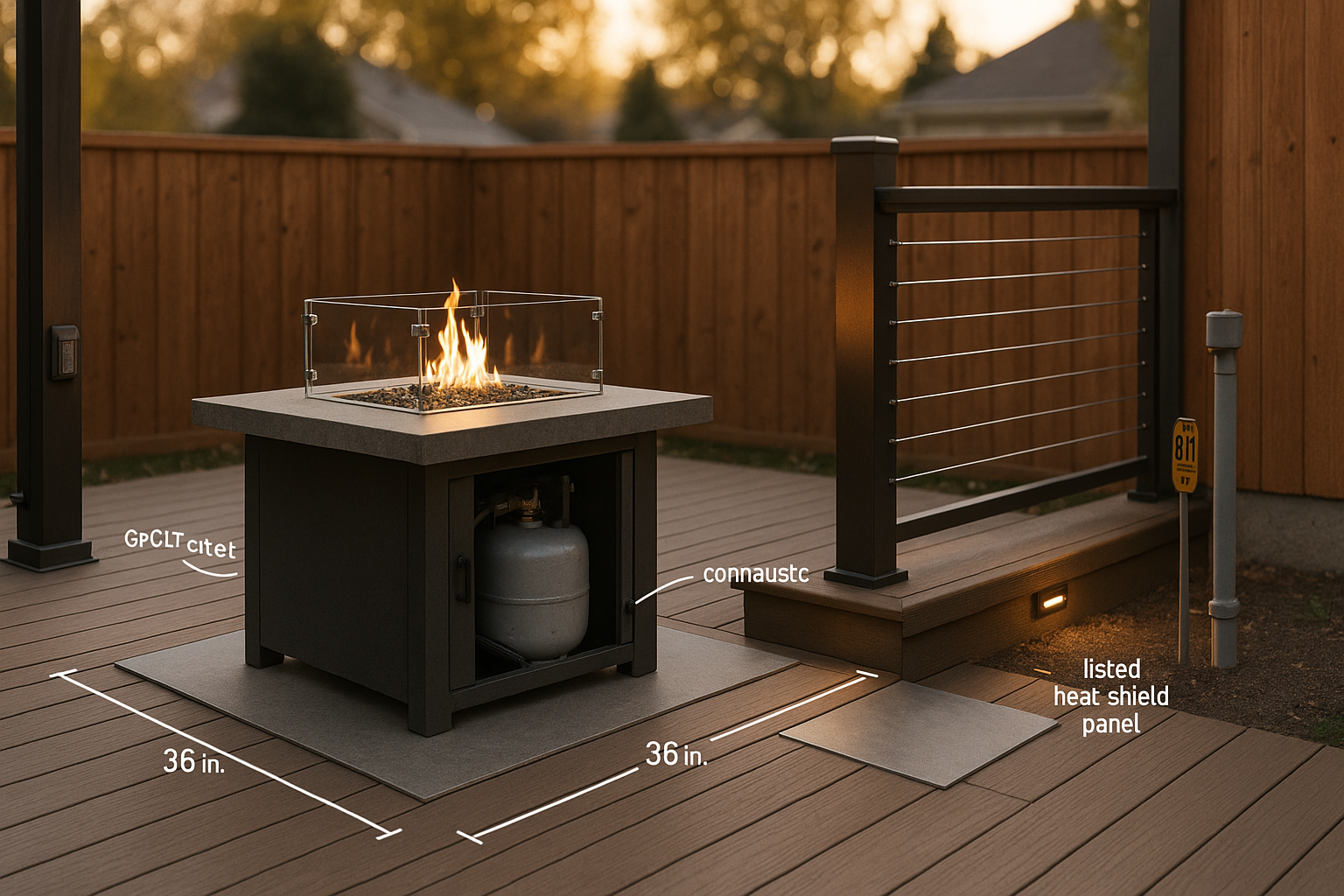
Composite and PVC decking can warp, discolor, or even melt when they get too hot. A fire table sitting directly on the boards? That’s asking for trouble. The radiant heat from the bottom of the unit can soften the material over time. But you don’t have to skip the fire feature. The fix is simple: put a non-combustible surface between the fire table and your deck. A porcelain paver inlay works great. So does a listed heat shield panel. At DeckPros, we usually recommend a paver inlay because it looks clean and handles the heat without any fuss. If you’re wondering “can you put a fire table on a composite deck,” the answer is yes — as long as you protect the deck underneath and follow the manufacturer’s clearance rules.
Gas or Propane? The Choice Changes Everything
Propane is the easiest option for most decks. You hook up a tank, and you’re done. Natural gas is more convenient if you don’t want to swap tanks, but it means running a gas line. In Indianapolis, that usually means a permit and a licensed contractor doing the work. You’ll also need a shutoff valve that’s easy to reach, and you might have to call 811 before anyone digs. If you’re in Carmel, Fishers, Westfield, or Zionsville, the rules are similar but some HOAs have extra layers. A contractor who knows the local gas line permit process can save you a ton of headaches. At DeckPros, we handle the gas line as part of the project, so you don’t have to coordinate three different trades.
How Much Space Does a Fire Table Really Need?
Clearances are the boring part until they save your siding. Most fire table manuals say 24 to 60 inches of side clearance from anything combustible, and at least 80 inches of overhead clearance if you have a roof. You also want 36 inches of clear walking space around the table so nobody trips into the flames. If your deck has railings — especially cable or glass — you need to think about heat clearance from those too. A railing contractor can tell you if your tempered glass panels are rated for the heat or if you need a heat deflector. Cable railings can get hot, so keep the fire table at least the manufacturer’s specified distance from the posts. And if it’s windy in your area (hello, Indiana spring gusts), a wind guard around the flame helps a lot. It keeps the heat where it belongs and can reduce the required side clearances slightly, but always check the manual first. For more on cable railing care near heat sources, see our post on cable railing tension and maintenance.
Will Your Deck Frame Handle the Extra Weight?
A fire table isn’t crazy heavy, but it’s not a plastic chair either. Most composite decks are built to handle 40 to 60 pounds per square foot, but a fire table plus a few people standing around means you need to check the joist spacing and blocking. If you’re planning a built-in fire table, you’ll want extra blocking underneath. And if you’re really worried about the heat degrading the framing over time, steel or aluminum framing near the fire zone is a smart upgrade. We’ve seen wood joists shrink and crack from repeated heating and cooling, especially in Central Indiana’s freeze–thaw cycles. A contractor can look at your deck structure and tell you if you’re good to go or need some reinforcement. Check out our article on steel and aluminum deck framing vs wood for more details.
Lighting and Electric: Keep It Low-Key and Safe
You probably want some low-voltage step lights or under-rail lights so you can see the fire table at night without blinding yourself. The key is to keep the wiring away from the gas line. They should cross at 90 degrees if they have to be near each other, and any outdoor outlets or transformers need GFCI protection per Indiana code. If you have a covered deck or are thinking about adding a patio enclosure later, a patio enclosure supplier can help you plan roof height and ventilation so the fire table doesn’t become a smoke trap. Low-voltage lighting near a fire feature is fine as long as you don’t run wires directly under the heat source.
Fences and Fire Tables: What’s the Connection?
Here’s one people forget: if your deck is close to a wood fence, that fence is a combustible surface just like your house siding. A fire table placed too close to a fence can scorch it or worse. A fence contractor can adjust the fence line or recommend a non-combustible section if you’re tight on space. Also, if you have a fence around your yard, make sure the gate doesn’t swing into the fire table’s clearance zone. It’s a small detail that can cause big problems.
HOA, Insurance, and Permits: The Paperwork You Can’t Skip
Before you buy anything, check your HOA rules. Some neighborhoods in Indianapolis and the suburbs like Carmel and Fishers have specific rules about fire features. A quick call to your HOA management company can save you a fine. You should also let your insurance company know you’re adding a permanent fire feature. It might raise your premium a little, but if something goes wrong and you didn’t tell them, they could deny a claim. Our post on how a deck affects home insurance in Indiana explains that in more detail. And if you’re running a gas line, you’ll need a permit. In Indianapolis, that’s the Department of Business and Neighborhood Services. Hamilton County has its own process. DeckPros can pull the permits and handle inspections for you, which is one less thing to stress about. Check out our deck permit and inspection timeline for Hamilton County for a realistic picture.
How DeckPros Plans Your Fire Table Project
When you call us about a fire table on a composite deck, we don’t just show up with a drill. We start with a site visit. We look at your deck structure, measure clearances to railings, siding, and fences, and check your gas and electrical options. Then we give you a clear scope: what surface protection you need, whether you’re going propane or natural gas, what lighting to add, and what permits are required. You get an itemized quote and a realistic timeline. No guesswork, no surprises.
If you’re in Indianapolis, Carmel, Fishers, Zionsville, Westfield, Noblesville, Greenwood, Brownsburg, Avon, or Plainfield and you’re thinking about a fire table on your deck, let’s talk. We’ll help you figure out what’s safe, what’s allowed, and what makes sense for your budget. Request a quote and we’ll come out and take a look.
Thinking about your own deck or pergola?
Free in-home design consultation, 3D rendering, and a written quote — no pressure.