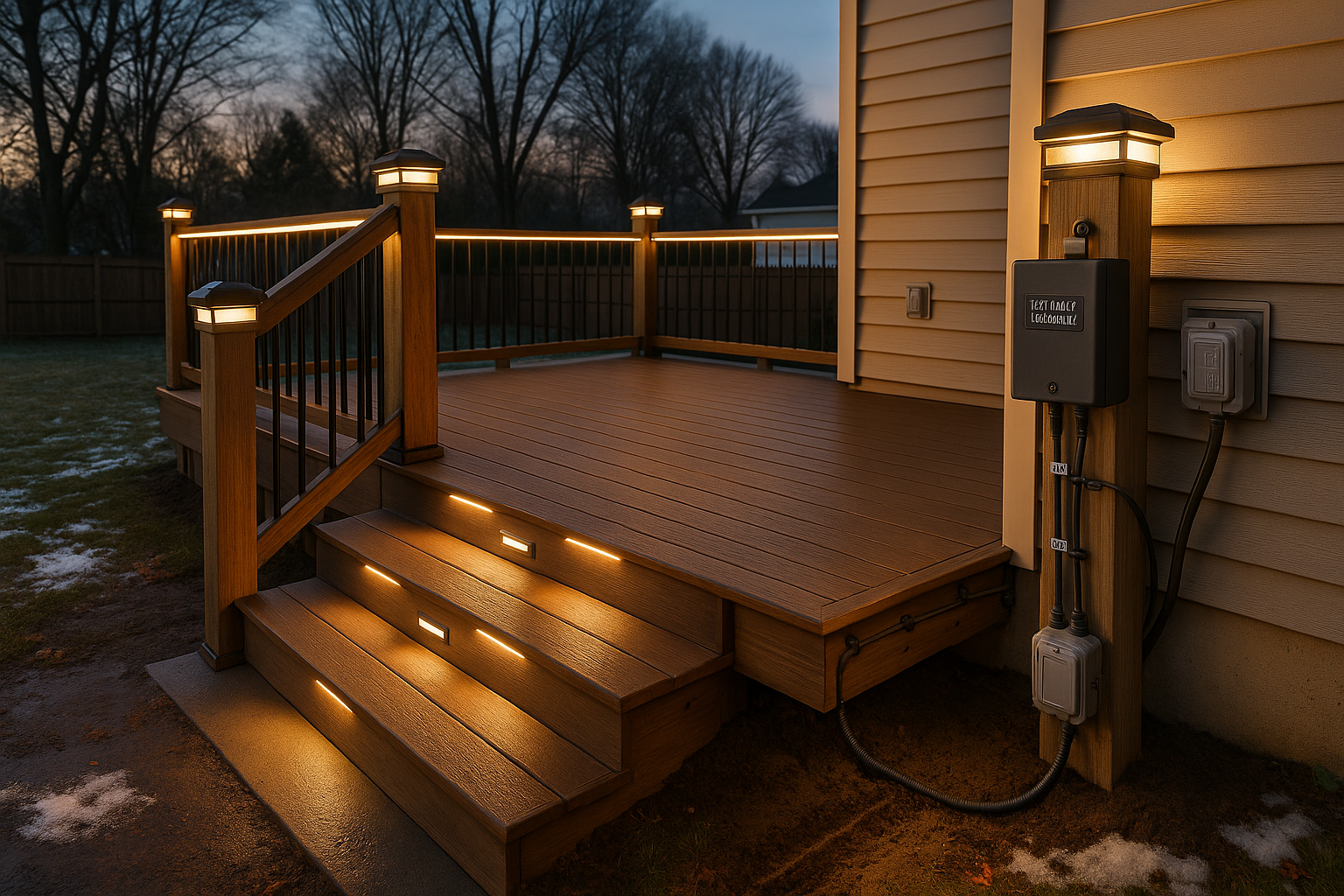
I remember the first time I tried to grill burgers at dusk on a friend’s deck in Broad Ripple. The deck was beautiful, but once the sun dipped behind the trees, it became a hazard. No lights on the stairs, the railing shadows swallowed the edges, and I nearly face-planted with a plate of raw patties. My friend shrugged and said, “Yeah, we just use our phone flashlights.” That’s when I realized—deck lighting isn’t just about mood, it’s about not breaking your neck. And if you’re adding lights, there’s a whole set of rules—the deck electrical code—that keeps things from getting dicey.
Here in Indianapolis, “deck electrical code” isn’t a single document. It’s a layered thing: the state-adopted electrical code (which is the National Electrical Code, or NEC, with Indiana amendments), plus any local tweaks from your city or county. In Marion County, the Department of Business and Neighborhood Services (BNS) is the authority having jurisdiction (AHJ). They’re the folks who’ll sign off on your permits and inspections. Even if you live in Carmel, Fishers, or Plainfield, your local building department plays by similar rules, but always double-check—codes can differ block by block.
So what does this mean for your deck? Most of the lights you’ll choose—stair lights, under-rail glow, post caps—run on low-voltage, usually 12V. That’s safe and pretty forgiving. But the transformer that powers them is plugged into a 120V outlet, and that outlet has to be weatherproof, GFCI-protected, and maybe even AFCI-protected if the AHJ says so. Outdoor receptacles for deck lighting need what’s called an “in-use cover”—a bubble that shields the plug while something’s connected. Indiana rain, melting snow, and even the mist from your sprinkler can trip a circuit or cause corrosion if you skip that cover. I’ve seen a corroded outlet turn a $200 transformer into a paperweight.
Why a Permit and Inspection Actually Help
I get it, nobody wants to invite an inspector over for a couple of deck lights. But here’s the thing: an Indianapolis deck lighting permit isn’t just red tape. It’s your insurance that the work won’t start a fire or fail dangerously. When DeckPros handles a project in Greenwood or Avon, we pull permits if needed—typically when we’re adding a new circuit or receptacle, not just plugging into an existing one. The inspection process is often quick: they’ll check the GFCI, the cover, the transformer mounting, and that the wiring isn’t a mess. And if you ever sell your home, a permitted, inspected install can be a selling point (something we talk about in our post on deck inspections before selling). So yeah, it might add a few days, but you sleep better.
Fixtures That Survive an Indiana Winter (and Summer)
Choosing fixtures that can handle Indy’s mood swings? That’s non-negotiable. Everything exposed to the elements—light housings, junction boxes, connectors—should be rated for wet locations. Look for “IP65” or “IP67” on the box; that means they’re sealed against rain and even temporary submersion. Our winters bring freeze–thaw cycles that can crack cheap plastic fixtures, and de-icing salts that love to eat metal. Corrosion-resistant hardware and UV-stable finishes will keep things looking clean years later.
And here’s where some other categories come into play. If you’re a Railing Contractor installing a sleek cable rail with built-in LED strips, you’re actually working with the deck electrical code too—those low-voltage wires need a clean, protected path down to the transformer, and metal railings might require bonding if the system is integrated with line-voltage components. (Most low-voltage setups don’t, but if you have a lighted railing that plugs into a 120V driver inside the post, check with your electrician.)
Fence Contractor? Not an obvious fit, but lots of Indianapolis backyards have decks that step down to a fence line. If you’re running low-voltage cable out to a transformer mounted on a fence post, that cable needs burial protection—typically 6 inches deep if it’s low-voltage landscape wire, but if it crosses under a path, conduit might be required. A well-coordinated fence and deck lighting plan means you won’t slice your cable while digging post holes later.
If your deck is enclosed or screened (a Patio Enclosure Supplier’s specialty), the lighting game changes. Inside a three-season room, you might not need wet-rated fixtures, but damp-rated ones are a must. And that outdoor outlet? If it’s now inside the enclosure, you might need to relocate it or add an additional one outside to feed the transformer. The code gets picky about having accessible, weather-protected power sources, especially in these semi-outdoor spaces.
As a general Contractor, DeckPros often acts as the glue. We communicate with the electrician, the fence guys, the railing suppliers—whoever’s touching the project. That way, you don’t get a beautiful new deck with an outlet hidden behind a bench or a transformer blocked by a shrub.
Wiring, Transformers, and Keeping the Lights Bright
Low-voltage cable seems harmless, but undersized wire is the top reason for dim, moody lights. If you run a 100-foot loop of 16-gauge cable powering 60 watts of LEDs, you could lose 2–3 volts by the end—your lights might look half-asleep. Use a voltage drop calculator, or have your installer spec the right gauge (12-gauge is cheap insurance for long runs). The NEC has tables for this, but the rule of thumb: keep voltage drop under 5%. And when you mount the transformer, it belongs off the ground, with breathing room, and a clear spot where it won’t get hit by a lawn mower or buried in snow.
Cable under the deck? You can run it along joists, but secure it every few feet and avoid pinch points where railings meet the deck boards. If you bury it between the deck and the transformer, go at least 6 inches deep or use rigid conduit—even for low-voltage. The NEC says “protected from physical damage,” and a shovel counts. For a deeper look at low-voltage installs in our area, check out our guide on deck lighting in Carmel.
HOAs and Local Quirks
One local headache: HOAs. In neighborhoods like those in Zionsville or Westfield, your homeowners’ association might have rules about light color temperature (warm white is usually fine, but no unfriendly blue), fixture style, or even whether you can see the transformer. You’ll need HOA approval for deck lighting if your changes are visible from the street. DeckPros helps by providing spec sheets and mockups that keep both the HOA and the code official happy.
Code Gotchas That Will Ruin Your Evening
I’ve seen too many avoidable flubs: - An otherwise perfect deck with a cheap, non-listed transformer that buzzed and died in the first rainstorm. - An outlet with no in-use cover, tripping the GFCI every time it got damp. - Mixing aluminum and copper connections without anti-oxidant paste, which corroded within a year. - A run of lights that worked fine in summer but dimmed in winter because the connections were never weatherproofed and moisture crept in.
If you’re thinking, “I’ll just plug a transformer into my existing outdoor outlet,” go for it—but make sure that outlet is GFCI-protected (it should have a test/reset button) and has a weatherproof cover. If it’s a plain outlet, you’re risking a shock hazard. Also, check that it’s not on a circuit that’s already overloaded. Adding a few dozen watts of LED lighting is usually fine, but if you’ve got a hot tub on that same circuit, you’re asking for trouble (we covered hot tub deck requirements in another post).
How DeckPros Tackles Your Lighting Project
We don’t just slap lights on and call it a day. We start with a planning meeting where we map out your deck, talk about how you’ll use it, and mark every fixture location so there’s no glare in your face when you’re trying to relax. We spec UL-listed transformers, outdoor-rated junction boxes, and fixtures that can handle an Indiana winter. We pull permits, coordinate inspections, and leave you with a clean, labeled installation that you won’t be afraid to show your neighbor.
If you’re in Indianapolis, Carmel, Fishers, or anywhere nearby, and you want deck lighting that’s safe, bright, and done right, reach out. We’ll walk your space, answer the code questions, and give you an itemized quote that spells out everything from wire gauge to in-use covers. Schedule a free planning consult through our quote page. Let’s make your deck the place you want to be after dark—without the phone flashlight.
Thinking about your own deck or pergola?
Free in-home design consultation, 3D rendering, and a written quote — no pressure.


