Last summer, a buddy in Fishers sent me a panicked text. He’d just filled his new hot tub on his back deck and the whole thing felt bouncy. Like, step in and watch the water slosh over the sides bouncy. He figured his ten-year-old deck was plenty strong. After all, it held his grill, some chairs, and a few friends just fine. A hot tub isn’t a few friends and a grill. If you live around Indianapolis—Carmel, Westfield, Zionsville, Noblesville, Greenwood, or anywhere nearby—and you’re thinking about a spa on your deck, you need to know the real hot tub deck requirements. They’re not what works for a regular deck. Not even close.
Why your regular deck won’t cut it
One of the most common questions we hear is, can a deck support a hot tub? The short answer: not without serious changes. Most decks are designed for 40 pounds per square foot (psf) of live load—people, furniture, some snow. A hot tub is a different beast. Quick math: a typical 7x7 tub holds about 400 gallons of water. Water weighs 8.34 lbs per gallon, so that’s over 3,300 lbs. Add the tub shell (800 lbs) and five bathers (875 lbs). Total? Roughly 5,000 lbs on 49 square feet. That’s over 100 psf—more than double what the deck was built for. And the pressure right under the tub’s base rails can be even higher. If your deck existed before you dreamed of a hot tub, it almost always needs major beefing up.
Permits and paperwork in Indianapolis
Before you buy any lumber, get a building permit. In Indianapolis and Marion County, that’s the Department of Business and Neighborhood Services (BNS). They’ll want to see plans with footing design and maybe an engineer’s stamp. Inspections too: footing, framing, final. If you’re in a neighborhood with an HOA—Meridian-Kessler, Broad Ripple, a northside subdivision—you’ll need their sign-off. We’ve built decks in many of those areas; take a look at our work in north side neighborhoods. And setbacks from property lines matter. Skipping permits is a bad idea. When you go to sell, or if something fails, it’ll haunt you. Pulling deck permits here isn’t scary, but you have to follow the rules.
Footings, frost depth, and our stubborn clay
Indianapolis sits on dense, sticky clay. It swells when wet, shrinks when dry, and heaves in winter. That’s why footings for a hot tub deck need to go down to the frost depth—typically 36 inches around here (verify current code). You’ll need bigger footings and closer spacing to fight uneven settling. Some folks opt for helical piles: they screw deep past the frost line and handle heavy loads without massive holes. Before you dig anything, call Indiana 811. Hit a gas line and your project stops cold.
Drainage, too
Clay doesn’t drain well, so plan for water to run away from the house. Slope the ground, lay gravel under the deck, and leave vents so moisture doesn’t rot the framing. A soggy, musty deck kills the hot tub vibe.
Beefing up the frame: posts, beams, joists
What does a hot tub-ready deck look like? Trade 4x4 posts for 6x6s. Beams under the tub area often go triple-ply or LVL (engineered lumber). Joists get doubled or tripled right beneath the spa, and spacing may shrink from 16 inches to 12 or less. All connections need heavy metal ties and hangers—and skip the cheap zinc ones. Spa chemicals (chlorine, bromine, salt) will eat regular fasteners. Use stainless steel or hot-dip galvanized hardware. For salt systems, 316 stainless is best.
A smarter move: concrete pad or helical piles
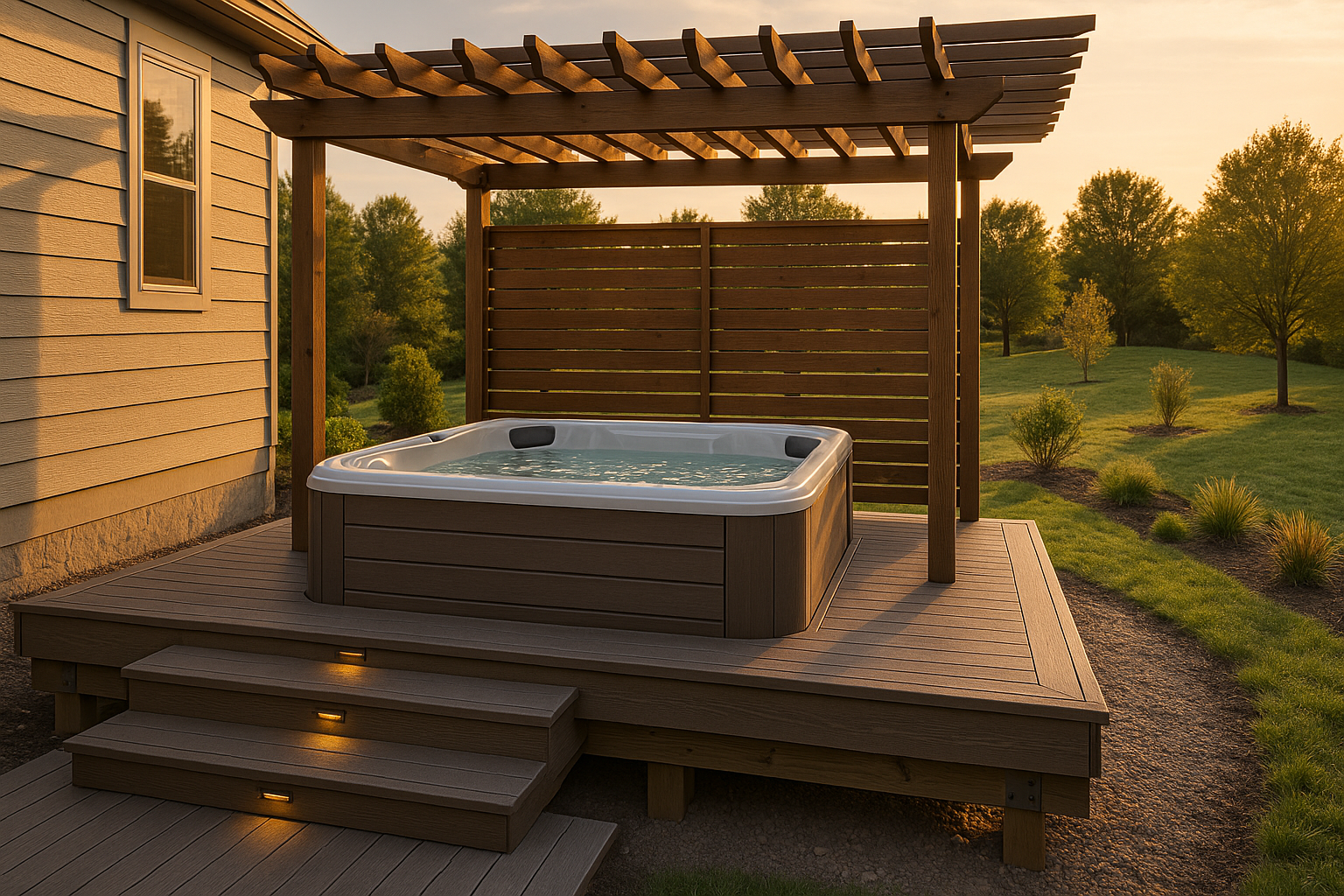
A lot of my Indianapolis clients skip the “super-deck” and put the hot tub on a concrete pad at ground level. Then we build the deck around it, maybe with a step down. That takes the weight off the deck entirely. Your framing only has to hold the surrounding platform and people, not 5,000 pounds of water. This approach also makes equipment access a breeze. We talk more about the concrete-vs-deck choice in our deck vs. patio comparison. Some use helical piles under the tub, which works similarly without a big concrete pour. Both are solid, and we’ll help you decide which fits your yard and your wallet.
Electricity near water: don’t DIY
I’m not an electrician, but I know the rules. A licensed pro needs to install a GFCI-protected circuit (usually 240 volts, 50–60 amps) and a disconnect switch at least 5 feet from the tub. All metal parts—tub frame, deck railing, hardware—must be bonded to prevent shocks. Keep the tub well away from overhead lines. Indiana follows the National Electrical Code with local tweaks. Hire a pro. It’s not optional.
Railings, fences, and privacy screens
Here’s where a solid railing contractor pulls double duty. Guardrails must be at least 36 inches tall (check your local rule; some want 42 inches). Balusters can’t be spaced more than 4 inches apart, and stairs need a grippable handrail. Around a spa, go beyond code: add a privacy screen or fence so you’re not on display for the neighbors. As fence contractors, we build custom cedar or composite screens that match your deck and give you that tucked-away feel. And if you later want to screen in the whole area against bugs, we supply patio enclosures that turn your deck into a three-season hangout. But that’s a story for another day.
Pick the right decking and hardware
Water splashes out—guaranteed. You need non-slip decking for a spa area, period. Textured composite, PVC, or a hardwood like Ipe all work. Ipe handles Indianapolis freeze-thaw cycles like a champ (though it needs some upkeep, which we cover in our Ipe maintenance guide). Composite stays cooler and is pretty much fuss-free. No matter what, avoid hidden fasteners right under the tub rails (you may need to remove a board for service). And again—stainless or hot-dip galvanized fasteners only, or you’ll see rusty streaks in a year.
Get your existing deck checked
Hoping to plop a hot tub on the deck you’ve already got? Please, get an inspection. I’ve seen too many decks with rotten ledgers, undersized beams, or posts sitting on a loose concrete block. That’s a collapse down the road. We do thorough checks, and our spring inspection checklist helps you spot trouble early. Spend a few hundred bucks now instead of thousands later when the deck buckles.
Little comforts: lighting and steps
Once the structure is bomber, add some low-voltage lighting on the steps and around the spa. It’s safe and sets the mood. We’ve got a full guide on low-voltage deck lighting in Carmel. Wide steps with deep treads make getting in and out easier—nobody wants to slip doing the awkward one-leg-over-the-side move. A shelf for towels and drinks, maybe a pergola for shade, and you’re golden.
Ready to plan? Let’s walk your yard
You could keep guessing, or you could have us swing by and take a real look. We’ll measure, test the soil, run the numbers, and lay out a plan that passes permits and inspections without surprises. We cover Indianapolis and the neighboring towns up north and west. When you’re ready to get serious about a hot tub deck, start here: schedule a site assessment. It’s the only way to know your project will actually work.
A final note on seasons
Winter here means freeze-thaw, snow, ice. Make sure your decking has enough grip when it’s slick. Use de-icers that won’t corrode your hardware or stain the boards. And think about where the hot tub cover lives on a windy January day—strapping it down beats chasing it into the neighbor’s yard.
Thinking about your own deck or pergola?
Free in-home design consultation, 3D rendering, and a written quote — no pressure.