Last summer my neighbor Mark shuffled over, holding a splintered chunk of his deck railing that looked like a dog had used it as a chew toy. "I'm scared this whole thing is gonna drop during the next family cookout," he half-laughed, but his eyes were serious. He'd been patching that deck for years—replacing a board here, sinking new screws there—but the stairs were spongy, the posts were wobbly, and you could smell the rot after a rain. When he finally decided to get it torn down, his first question was the one every Indy homeowner asks: "What's this gonna cost me?"
Deck removal cost in Indianapolis isn't a single number. It can be as low as a few hundred bucks for a tiny, ground-level platform or climb to several thousand for a multi-level beast with deep footings and tricky access. Most folks end up somewhere in the middle, but the only way to know for sure is to understand what drives the price. So let's walk through the real-world numbers—no fluff, no scary markups—just what you can honestly expect when you hire a crew to demolish and haul away your old deck.
What you'll actually pay to tear down a deck in Indy
The simplest way to ballpark deck demolition cost is by square footage. For a basic tear-down and load-out, the going rate around Indianapolis is roughly $6–$12 per square foot. That includes cutting the deck into manageable chunks, pulling fasteners, and loading everything into a dumpster or trailer. So a common 10x10 deck (100 sq ft) might run you $600–$1,200, while a more typical single-level 200 sq ft deck lands between $1,200 and $2,400.
But that's just the starter number. Most decks have stairs, railings, and at least a couple of stubborn concrete footings buried deep in our heavy Indiana clay. Those extras bump the total fast.
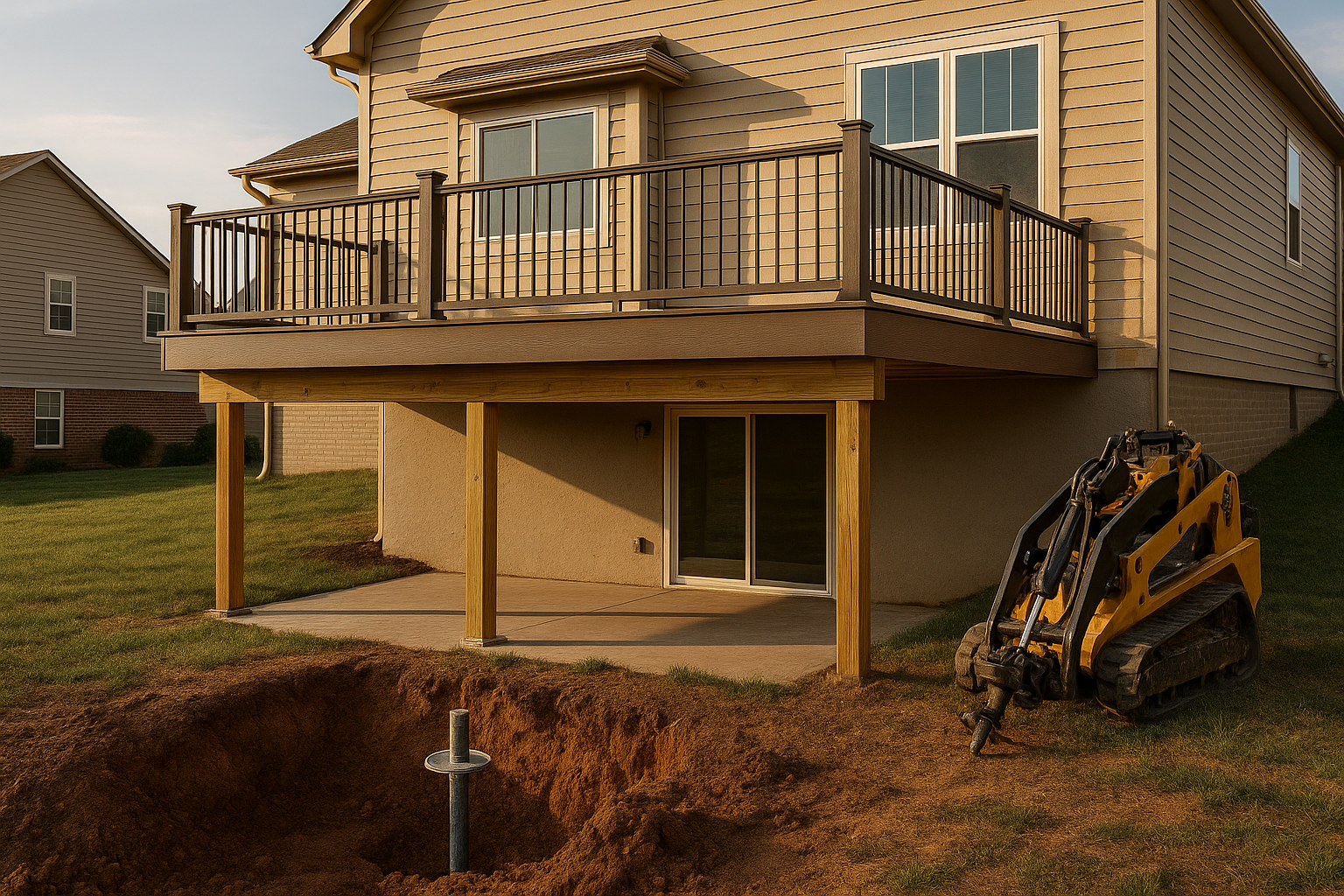
Take a 250 sq ft deck with three steps and a simple wood railing. The tear-down might be $1,500, but you're probably adding another $200–$400 for the stairs and rails just because of the extra cutting and hardware. If the footings need to come out—and in Central Indiana, they often reach 30–36 inches down to get below the frost line—expect to pay $75–$200 per footing for full extraction. A deck that size usually has four to six footings, so that's another $300–$1,200 right there.
And if your deck is built from that heavy 1990s-era pressure-treated lumber that's soaked up years of moisture, or (worse) composite boards that weigh twice as much as wood, the disposal costs climb because of the sheer weight. No one wants to talk about dumpster fees, but they're real: hauling away an average deck's debris can run $200–$600 depending on volume and what the local transfer station is charging. That's your deck disposal fees Indianapolis budget, right there.
One more thing: where you live matters. In neighborhoods like Broad Ripple or Irvington, backyards can be tight. If the crew has to hand-carry every piece of lumber through a narrow gate or down a long side yard, that means more labor hours. In Meridian-Kessler, we've had to dismantle entire decks with hand tools because we couldn't get equipment past the house. That's not a complaint—it's just the reality of older neighborhoods, and it's something to watch for in your quote.
Hidden surprises that can swell the bill
Here's where I've seen homeowners' jaws drop: the ledger board. That's the horizontal beam bolted to your house that the deck attaches to. In a perfect world, it's flashed properly and everything's dry behind it. But this is Indiana. Freeze-thaw cycles, heavy humidity, and years of leaf litter sitting against the siding can turn that ledger—and the rim joist behind it—into a mushy mess. When you rip the deck off, you might expose rotting wood that needs to be cut out, repaired, and re-sided. Tack on another $300–$800 for a small section of ledger board removal and siding repair, and double it if the damage runs wide.
Then there's the permit question. Not every deck removal needs a permit, but if the structure is attached to your house and you're altering the house envelope, some townships want to know. DeckPros checks all that for you and pulls the permit if it's required—it's not a big fee, maybe $50–$150, but it can trip up a DIY job if you don't think about it.
And honestly, the biggest wildcard is what you find under the deck. I remember a job in Greenwood where the homeowner just wanted the deck gone so he could sell. We pulled the boards and found that carpenter ants had hollowed out half the framing. The deck was holding together by habit more than structure. That didn't change the demolition price much, but it meant the house needed immediate structural repairs—something he was glad we caught before a home inspector did.
DIY deck removal: money-saver or headache factory?
You're probably watching those YouTube videos right now thinking, "I've got a sawzall and a free weekend. How hard can it be?" I get it. And for a small, ground-level deck, maybe you can pull it off. But here's what Mark in Fishers told me after he tried: "Never again."
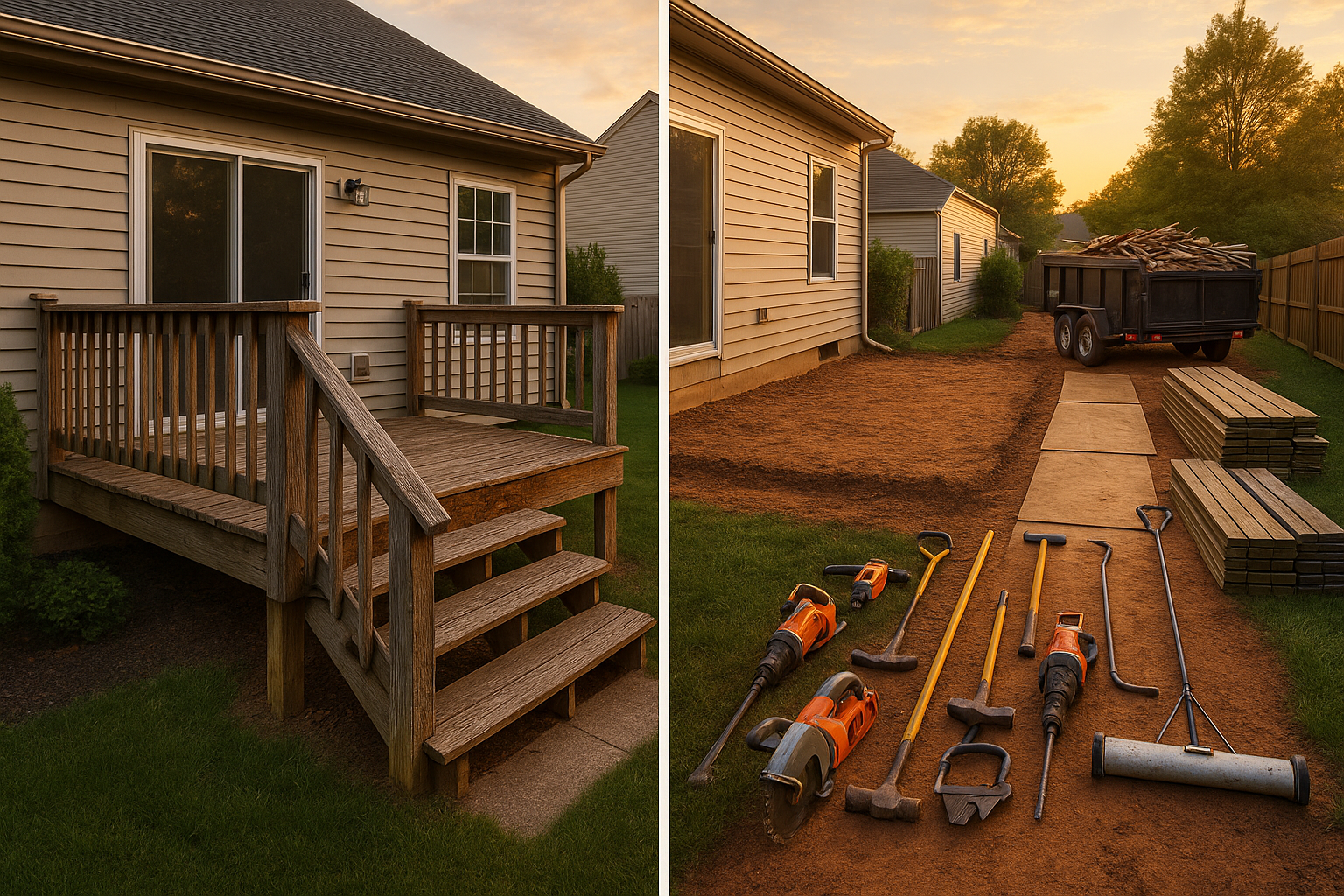
He figured he'd save $1,000 by removing his 150 sq ft deck himself. What he didn't figure: renting a jackhammer for the footings ($80/day), buying extra blades and a crowbar, the emergency room co-pay when a rotted board gave way and he landed on a rusty nail, the three weekends it took instead of one, and the $350 dumpster he still had to order—then overfilled because he didn't know how to pack it. In the end, he said all he'd saved was his dignity, barely.
If you value your time at more than zero dollars an hour, hiring a pro almost always pencils out. A crew like DeckPros brings insurance, experience, and the right tools. We can knock out a typical 200 sq ft deck in four to eight hours, including clean-up. And we know the local disposal rules—like the fact that old treated lumber can't just be tossed in curbside pickup; it has to go to a proper facility. That's one of those "Indiana treated lumber disposal rules" that can get you in trouble if you're not paying attention.
Also, if your deck removal impacts a fence—say, a section needs to come out to get machinery in—a contractor who's also a fence contractor can handle that seamlessly. (We are, so it's just part of the job, not a separate headache for you.)
After it's gone: repair, rebuild, or something else entirely?
Taking down the deck opens up options. Maybe the framework underneath is still solid—though in my experience, that's rare after 15 or 20 Indiana winters. If just the decking and railing are shot, you might get away with a repair. But when we pull up boards and see split joists, rusted hangers, or footings that have heaved out of level, it's usually smarter to start fresh.
That's when the conversation turns to rebuild: wood vs composite, basic vs fancy. Composite materials cost more upfront but handle our humidity better, and you won't be staining every other year. (Check out our post on deck lifespan composite vs wood here in Indiana for the full breakdown.) And if you're thinking of selling soon, a new deck—or even just a clean, graded pad where the old one stood—can look way better to buyers than a rotting liability. Something we talk about a lot with folks who've just had a deck inspection before listing their home.
Sometimes homeowners realize they don't even want a deck anymore—maybe a covered patio enclosure would serve them better. As a patio enclosure supplier, we can design that too, handling the transition from open deck to screen room or sunroom. Or if the old railing was the only thing truly failing (and I mean only the railing, not the structure behind it), we can do just a railing replacement. But honestly, when railings are loose, the posts are often rotting inside the deck frame, and then it's a bigger project.
What working with DeckPros actually looks like
When you call us, we come out and walk the site. No charge for the estimate. We'll measure everything, poke around the ledgers and posts, and listen to what you want: just tear it out, or tear out and build new, or maybe repair what's savable. Then we send you a written scope with line items—demolition, footing plan, disposal, any siding or fence work—so there's no mystery.
During the job, we protect your turf and hardscape, we magnet-sweep for stray nails until the lawn is safe for barefoot kids, and we leave the site cleaner than we found it. Most single-level decks are down in half a day; bigger or trickier ones might take a full day or slightly more. If we need to pull up footings or repair that ledger, we'll have it all scheduled so the rebuild crew can hop in right after.
And no, we don't surprise you with add-ons. If we see potential rot or hidden damage, we talk to you first, show you what's there, and give you a change order with a clear price before we touch it.
Ready to stop worrying about that old deck? Grab a no-obligation quote right here—pick a time, and we'll swing by, take a look, and hand you a straightforward plan. No pressure, no B.S.
Thinking about your own deck or pergola?
Free in-home design consultation, 3D rendering, and a written quote — no pressure.