You walk out onto your deck one morning and notice it. A gap between the deck and the house. Maybe just a quarter inch, but you know it wasn’t there last year. You push on the railing and feel a little give. That sinking feeling in your stomach is justified — your deck’s ledger board might be failing.
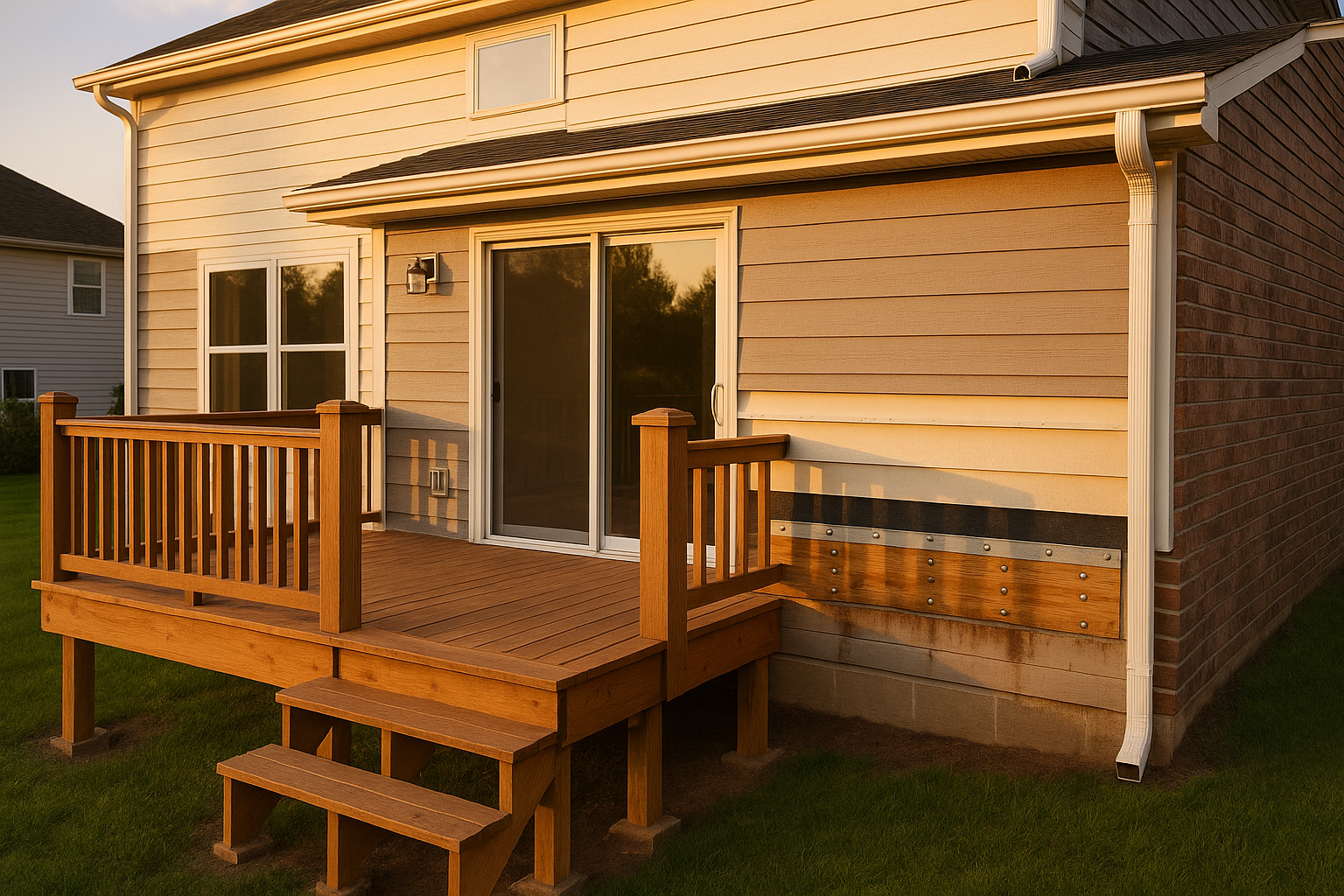
A few months ago, a homeowner in Meridian-Kessler called us after finding a soft spot near the back door. We pulled back a strip of vinyl siding and found the ledger board completely rotted behind a piece of old flashing that had been installed upside down. The nails that held it up were nearly gone. It was a slow surprise, and a dangerous one.
Your deck ledger is the board that bolts your deck to your house. It carries the entire weight of the deck and your family. When it fails, the deck can collapse. But here’s the good news: this problem is fixable, and in most cases, your deck doesn’t need a total rebuild.
What Causes Deck Ledger Failure in Indianapolis Homes?
Indiana weather is rough on decks. Our freeze-thaw cycles push water into tiny gaps, then expand them. Summer storms blow rain sideways against the siding. And if you have a shaded north-facing deck — common in neighborhoods like Broad Ripple or Carmel — the ledger stays damp longer, inviting rot.
Most failures come down to one thing: water getting behind the ledger where it can’t dry. The usual culprits include: - Missing or wrong flashing — sometimes there’s none at all. - Siding not cut back — vinyl siding was run right over the ledger, trapping moisture. - Nails instead of structural fasteners — old decks from the ’90s and early 2000s often used nails or undersized lag screws. - Gutter overflow — a short downspout dumping water right where the ledger meets the house.
Add in the fact that many suburban decks built around Fishers and Zionsville in the 2000s used pressure-treated lumber that wasn’t treated for ground contact — and the conditions are perfect for failure.
Signs Your Deck Is Separating from the House
You don’t need to be a contractor to spot trouble. Look for these warning signs: - Gap between deck and house — even an eighth of an inch is a red flag. - Rust stains on the siding below the ledger. - Soft or mushroomed wood near the house where the deck attaches. - Bouncy feel when you walk near the house line. - Leaks in the basement ceiling beneath the deck — water can travel through the rim joist.
If you see any of these, don’t ignore them. A deck that pulls away from the house is a safety hazard. We’ve seen decks held on by nothing more than a few rusty nails.
Our Assessment Process: No Guessing, Just Facts
When we come out, we don’t just look at the ledger. We expose the whole area so we know exactly what we’re dealing with. Here’s what we do:
- Remove a strip of siding above the ledger — carefully, so we can put it back.
- Probe the rim joist (the band joist in the house) behind the ledger.
- Check flashing — is it there, is it shingled correctly, is it corroded?
- Measure fastener spacing and type — nails? Screws? Bolts? Count them.
- Moisture test the wood.
- Document everything with photos and a written scope.
Most ledger repairs can be done in one to three days. If the rim joist has rot, we may need to replace a section — that adds time but is still a fraction of a full deck rebuild.
Repair Options: Fixing It Right for Indianapolis Weather
Once we know the damage, we pick the right fix. Here’s what that might be:
Re-flash and Re-fasten a Sound Ledger
If the ledger board itself is still solid but the fasteners or flashing failed, we can clean it up, install proper self-adhered flashing membrane, add continuous metal Z-flashing, and put in code-approved structural screws or through-bolts with washers. We always use hot-dip galvanized or stainless steel hardware — never nails.
Replace a Rotton Ledger and Damaged Rim Joist
If the ledger is soft or the rim joist behind it is rotted, we cut out the bad wood and sister in new pressure-treated Southern Pine. We install peel-and-stick flashing that ties into the home’s weather resistive barrier (WRB). Then we attach a new ledger with Simpson Strong-Tie ledger fasteners or equivalent through-bolts.
Add Lateral Load Connectors
Many older decks lack connectors that resist sideways movement from wind or heavy snow. We add Simpson lateral load connectors to tie the deck to the house framing — a simple upgrade that dramatically improves safety.
When a Ledger Isn’t Right: Free-Standing Decks
Some homes can’t safely use a ledger attachment. Brick veneer is tricky — you can’t bolt directly into brick. Likewise, if the house framing behind the ledger is compromised, it’s often smarter to convert the deck to a free-standing structure adjacent to the house. It means digging footings and building a separate frame, but it’s the safest solution.
Permits and Code in Indianapolis and Beyond
Yes, a permit is needed for most ledger repairs in Marion County and surrounding areas. We handle the paperwork — we know the inspectors and the current building codes. Attachment patterns, fastener types, and flashing details are designed to meet or exceed local code. We’ve worked with permit offices in Indianapolis, Carmel, Fishers, Zionsville, Westfield, Noblesville, Greenwood, Brownsburg, Avon, and Plainfield.
Why Our Flashing Matters (Especially in Indiana)
Flashing is the unsung hero of a safe deck. We always: - Cut back vinyl siding at least one inch above the ledger. - Install self-adhered membrane that laps over the WRB. - Add a continuous metal Z-flashing that directs water away. - Make sure the drainage plane is maintained — water that hits the house needs a path to the ground.
We’ve seen what happens when flashing is done wrong. A home in Brownsburg had a ledger that was fully encased in siding with no flashing. The rot behind it was so bad the deck had to be taken down. It could have been saved with proper flashing.
Protecting Your Home and Yard During Repair
We’re careful with your siding. We remove it neatly and reinstall it so it looks good and seals tight. We protect your landscaping and clean up daily. Your home is your castle, and we treat it that way.
What About Winter or Rain?
Yes, we work through cold and wet weather. Some phases — like pulling flashing — are better done in dry conditions, but we schedule around that. If a storm rolls in, we tarp and protect everything. Your timeline will be spelled out in the plan.
Frequently Asked Questions
Can I just add more screws and call it good?
No. A few extra screws won’t fix missing flashing or rot. You need a proper inspection and repair plan.
Will you have to tear off a lot of siding?
Usually just one or two courses above the ledger. We reinstall it carefully — often you can’t tell we were there.
What if the rim joist is rotten?
We replace the damaged section. In most cases, it doesn’t require a full deck rebuild.
Is converting to a free-standing deck more expensive?
It can be, but if your home isn’t suited for a ledger, it’s the only safe option.
Your Next Step
If you’ve noticed any of the warning signs we mentioned, don’t wait. A deck ledger failure doesn’t fix itself. Our team will come out, assess the spot, and give you a written plan with clear scope, materials, timeline, and cost. No surprises.
Schedule your ledger inspection here — we serve Indianapolis and all the surrounding communities. Let’s make your deck safe again.
Thinking about your own deck or pergola?
Free in-home design consultation, 3D rendering, and a written quote — no pressure.