Last October, my buddy Kevin in Carmel texted me a photo of his deck at 7 p.m. — empty. He'd spent all summer grilling out there, but once the sun dropped and the wind picked up from the west, his wife said no way. He was staring at a six-month-old composite deck that would sit unused until April. That's what pushed him to finally look into a deck heater. Not just any patio heater you drag out and refill, but something built into the pergola he'd been planning. And honestly? That one upgrade changed how his family uses the house from September through Thanksgiving.
If you're in Indianapolis or the north suburbs, you know the drill. One day it's 75, the next you're pulling out the fleece. A good deck heater isn't a luxury — it's a tool that lets you actually use the space you paid for. But there's a right way and a wrong way to do it, especially under a pergola. So let's talk about what works, what doesn't, and what's safe.
Why heat your deck at all?
Central Indiana weather is a tease. A warm October afternoon can turn into a 40°F evening real quick. And forget March — half the month is still winter. If you have a deck, a pergola, or even just a slab with some chairs, heat extends your outdoor season by six to eight weeks on each end. That's more dinners outside, more football watch parties, more mornings with coffee before the kids wake up.
I've heard from homeowners in Fishers and Zionsville who planned a full outdoor kitchen but forgot about heat. They spent $20,000 on a grill island and then couldn't use it after dark in November. That's backwards. Heat first, then the fancy stuff. Or at least plan for both at the same time.
Types of deck heaters for your pergola
You've got three main options, and they all serve different needs.
Electric infrared heaters
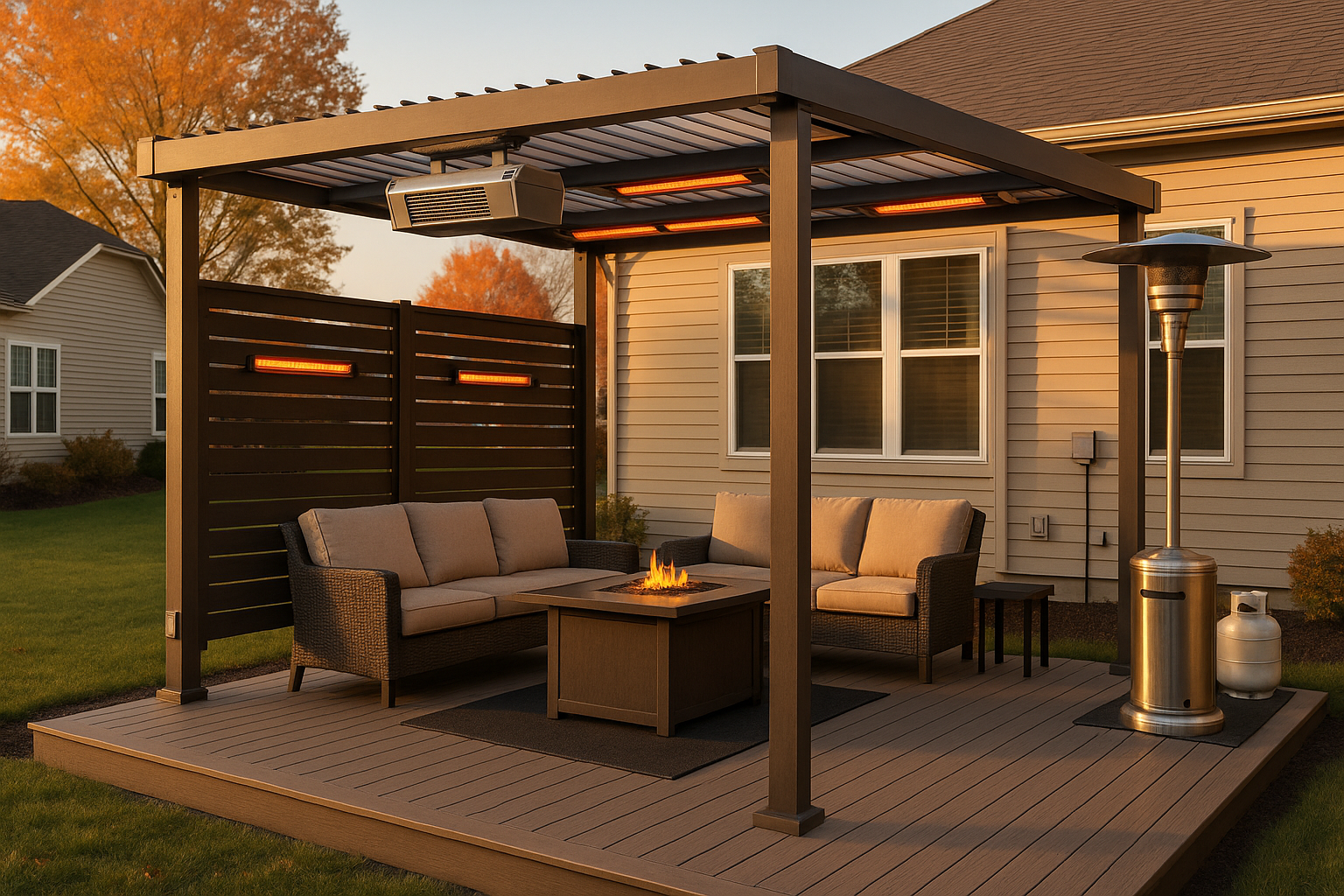
These are my go-to for a pergola. They mount overhead or on a wall, they're quiet, and they warm people directly, not the air. That's important because Indiana wind will steal convective heat fast. Infrared is like standing in the sun — even on a 30°F day, if the heater is aimed at you, you feel warm. They run on 120v or 240v. A 240v unit puts out more heat but needs a dedicated circuit. Most homes in Indianapolis can handle it, but you might need a panel upgrade if you're already maxed out. I always check first.
Natural gas or propane ceiling units
If you already have gas to the house, a natural gas deck heater can put out serious BTUs. But you need a gas line run to the deck, which means trenching (call 811 before you dig — see our post on that /blog/call-811-before-deck-footings-indiana/). Gas heaters need more clearance from combustibles and you need to think about ventilation. Don't ever run one in a fully enclosed porch. Semi-open pergolas? Usually okay, but check the manufacturer's clearance labels. Propane is an option, but then you're dealing with tanks. Fine for a portable unit, less great for a permanent install.
Fire tables and portable propane heaters
Fire tables look great and give you that ambiance, but they're not great at heating a whole deck on a windy night. They mostly heat what's right next to them. Portable propane patio heaters are cheap, but they're top-heavy, they blow over, and you have to store them somewhere. If you have a composite deck, you need a heat shield or a mat underneath because the burner can get hot enough to soften the decking. We covered some of those clearance issues in our grill placement post — same logic applies.
Safety first: clearances, codes, and common mistakes
This is where I see homeowners screw up. They buy a $300 heater from a big box store, mount it too close to the pergola beam, and then wonder why the wood is discolored or, worse, they smell smoke. Every heater has a minimum clearance from combustibles — sometimes 6 inches, sometimes 18. That includes wood, vinyl, fabric, and even polycarbonate panels. A fabric shade might look nice, but if it's 10 inches above an infrared heater, you're playing with fire. Literally.
Indiana code (and the NEC for electrical) has rules about outdoor circuits, GFCI protection, and in-use covers. If you're running a 240v circuit, you need a permit in most cities. A good contractor will pull that for you — it's part of the job, not an add-on. And if you're running gas, you need a permit too. Don't skip it.
Sizing and wind: what actually works in Indianapolis
One heater on a 12x16 pergola might barely take the edge off if the wind is howling from the west. Which it does. A lot. So you have to think about zones. Most radiant setups aim for 10–20 watts per square foot, or about 15–35 BTUs per square foot, depending on how open the space is. But those numbers assume no wind. On a breezy day, you can lose half your heat. That's why wind screens or privacy panels help. As a fence contractor, we can integrate those into the pergola design — not just ugly plastic sheeting, but real panels that match your railing and block the west/northwest wind that rips through Broad Ripple and Avon.
Design for a clean look: wiring, gas, and structure
The best pergola heater installs are invisible. You don't see any conduit, no exposed gas line, no ugly brackets. That takes planning. We route wiring inside hollow posts or along beam edges, paint conduit to match, and use stainless steel hardware that won't rust. If you have a composite deck, we pay attention to how the heater mounts — you don't want to drill through the deck surface. That's why we prefer overhead mounts. Sometimes a deck railing is in the way of a good heater spot, so we might adjust or replace it. Since we also do railing work, it's one less trade to coordinate.
If you're adding a pergola with a louvered roof or polycarbonate panels, the heater has to be mounted below the panels, and you need to check the panel manufacturer's heat tolerance. Some polycarbonate will warp or discolor if it gets too hot. We can advise on that, and as a patio enclosure supplier, we work with materials that are actually rated for overhead heat.
Retrofitting heaters into an existing pergola
Yes, you can add heaters to a pergola that's already built. It just takes a little more work to run power or gas up to the beams. We've done it in Meridian-Kessler, where the pergola was original to the house and the homeowner didn't want to tear anything apart. We fished wires through existing beams, added a weatherproof outlet near a post, and mounted two slim infrared units. It took a day. Now they use that space all winter long.
Maintenance and winter prep
Heat doesn't need much, but you should wipe down reflectors every few weeks during pollen season (fall leaves and spring blossoms will collect). Check the mount bolts before each season, and if you have a portable propane heater, store the tank outside, never in the garage. In the winter, if you're not using the deck, you can cover the heaters with a breathable cover — but make sure they're cool first.
Ready to extend your season?
If you're tired of looking at a dark, empty deck from September to May, let's talk. Heating a deck isn't just about buying a unit — it's about planning the structure, the power, the clearances, and the wind. That's what we do. We're a local contractor serving Indianapolis, Carmel, Fishers, Zionsville, Westfield, Noblesville, Greenwood, Brownsburg, Avon, and Plainfield. We'll come out, measure your space, check your panel, and give you a straight answer on what will actually work. No pushy sales, no guesswork. If you're thinking about a pergola or already have one, start with a conversation. (Off-season pricing can be better too — /blog/why-deck-quotes-drop-in-the-off-season/.) Get a free, no-pressure quote here: /#quote.
Thinking about your own deck or pergola?
Free in-home design consultation, 3D rendering, and a written quote — no pressure.