My neighbor Dave spent two summers chasing his patio chairs across the yard whenever a storm blew through. Last spring, after a gust sent one into his new grill, he called me over and said, “I’m done. I want seats that stay put.” He ended up with a built-in corner bench along his deck perimeter, and now his Saturday cookouts don’t start with a scavenger hunt. That’s the thing about a built in deck bench—it’s not just about looks. It solves real problems for Indianapolis homeowners, like wind, tight yards, and the hassle of storing furniture every winter.
If you’re weighing built-in seating against buying another outdoor sofa, you’re probably asking the same questions Dave did: Will it make my deck feel cramped? Is the cost worth it? What do I have to know about code, materials, and maintenance around here? I’ve been around enough deck projects in Indy to tell you: a well-planned built in deck bench almost always wins, especially when you do it with the right crew.
Why a Built-In Bench Makes Sense Here
Indianapolis backyards aren’t huge. In neighborhoods like Broad Ripple, Fountain Square, or up in Carmel, you’re often working with postage-stamp lots or older homes with modest decks. A built-in bench hugs the edges, so you aren’t sacrificing floor space for seating. Even in newer suburbs like Fishers or Westfield, where lots are bigger, a perimeter bench keeps the middle open for a table, grill, or kids running around.
Beyond space, there’s the wind. If you’ve ever lived in Avon or Plainfield with wide-open yards, you know that a sudden gust can rearrange your outdoor setup in seconds. Built-in seating doesn’t budge. And unlike a set of chairs you have to drag into the garage come November, these benches stay put through snow and rain—just brush them off and you’re good. Dave won’t admit it, but I think he spends more mornings with his coffee out there now, just because there’s always a spot waiting.
For families, built-ins are safer than lightweight furniture. No tipping risk when kids climb up, and you can stash toys or cushions inside a storage bench. Speaking of storage, if you’re working with a contractor who knows their way around framing, they can build you a boxed seat with a soft-close lid that doubles as a spot for pool noodles or gardening gear. Our crew has done that plenty on projects from Zionsville to Greenwood—it’s one of those features that makes a deck work harder.
Design Ideas That Fit Your Deck (and Your Life)
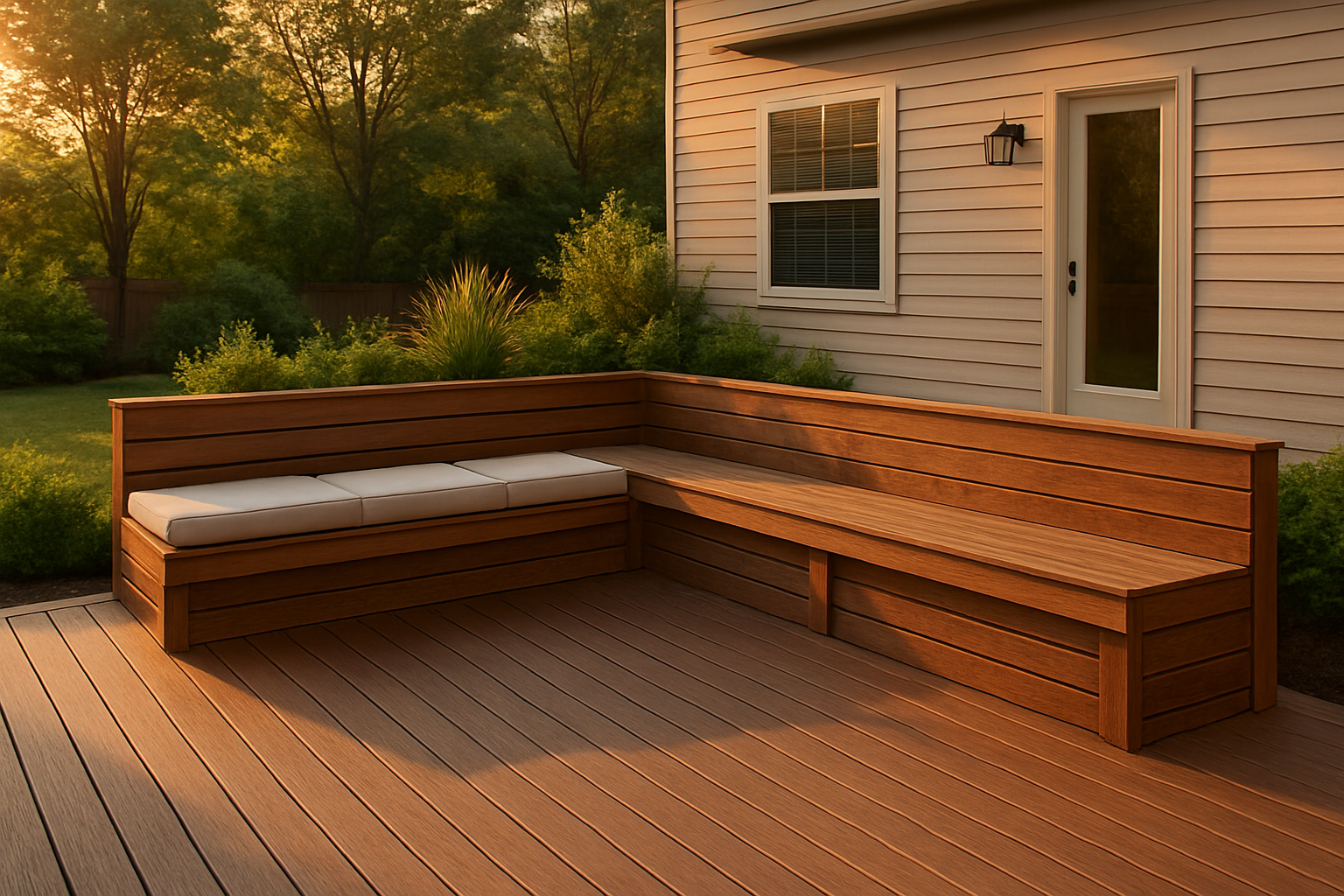
The most popular setup we see is an L-shaped bench in a corner. It naturally creates a conversation nook and uses space that would otherwise be dead. In Noblesville, we built one with a backrest angled at about 12 degrees, and the owner told us it’s more comfortable than her living room couch. You can go with a U-shape if you entertain big groups, or a simple straight run along one side for a minimalist look. Curved benches are trickier to frame but they soften a deck’s look and feel custom, which a lot of Brownsburg homeowners appreciate.
Backrest or backless? Backless benches feel more open and work well on small decks where you don’t want to block views. But if comfort is king, a backrest is worth it. We often combine a backrest with integrated planters behind it—that way you get greenery and privacy without taking up more floor space. And if you’re adding a privacy screen or a section of railing near the bench, talk to a railing contractor. They can help tie the bench into the guardrail system seamlessly, so it looks like one cohesive piece, not an afterthought.
One thing to keep in mind: a bench near the edge still needs a proper guardrail if the drop is high. Indiana code says you need a 36-inch guard if the walking surface is more than 30 inches above grade. The bench doesn’t replace that. So if you’re picturing a backless bench with no railing behind it, that only works if the deck is low enough, or if the bench is set back from the edge far enough that the guard isn’t needed right there. Always check with your local building folks or a pro who knows Marion County rules.
Dimensions: The Difference Between “Fine” and “Forget It”
Ever sat on a bench that felt like a perch? Or one so deep you sank back and couldn’t reach your drink? The sweet spot for seat height is 17 to 19 inches. Depth: shoot for 15 to 18 inches without a backrest, and 18 to 20 if you want lean-back comfort. That extra depth gives your thighs room without cutting off circulation. We pitch the seat surface forward about 2 to 5 degrees—just enough so rainwater doesn’t pool, but you’re not sliding off.
Don’t ignore the small stuff. Eased edges on the front of the seat board save the backs of your legs. A quarter-inch drainage gap between boards lets water through and keeps the top dry faster after a summer shower. And if you’re adding a backrest, angle it 10 to 15 degrees back from vertical. It feels natural, like the driver’s seat in a car.
Structure and Code: Not as Boring as It Sounds
I’ve seen too many DIY benches sag after one winter. The bench needs its own framing—you can’t just screw a board to a couple fence posts and call it good. We normally build blocking between joists and run doubled-up framing members specifically for the bench. If you’re adding a bench to an existing deck, we might cantilever supports out from the rim joist, or add new footings if the load requires it. Stainless steel fasteners (at least 304 grade, often 316 if you’re near a chlorinated pool) are non-negotiable around here. Humid summers and freeze-thaw cycles will chew up regular hardware fast.
If you’re using composite or PVC, thermal expansion is real. You can’t butt boards tight; leave gaps according to the manufacturer’s specs. On hot Indy afternoons, a dark composite bench can get toasty on bare legs. Lighter colors help, or you can throw down cushions. As a patio enclosure supplier might advise, orient your seating to catch shade from the house or a pergola during peak sun hours.
Permit-wise, if you’re messing with the deck structure or guards, the city probably wants to know. In Indianapolis, a building permit is likely if you’re adding a bench that attaches to the house or modifies load-bearing framing. HOA approval is another layer, especially in neighborhoods like those in Fishers or Carmel. Don’t skip it—you don’t want a fine or a teardown order.
Materials That Survive Indiana
For low maintenance, composite and PVC benches are tough to beat. They won’t splinter, they resist rot, and you just hose them off a couple times a year. A PVC bench costs more but won’t fade or stain as easily as some composites. Cedar and pressure-treated pine are easier on the wallet, but you’ll be sealing or staining them every year or two to keep them from graying and splintering. Ipe is the luxury option—dense, naturally weather-resistant, and beautiful—but it’s heavy and demands a skilled installer.
No matter the material, ventilation matters. If you build a storage bench, don’t seal it up tight. We drill vent holes in the sides or use a slatted bottom so air moves through. That keeps mildew at bay even in those sticky July weeks. And always plan a slight gap under the bench for water to escape—a drip edge or a space of about a half-inch works.
What Will It Cost?
In Indianapolis, a basic wood bench with no storage or backrest usually runs $65 to $120 per linear foot, installed. Composite pushes that to $110 to $180. Add backrests, planters, lighting, or tricky access, and the price climbs. Retrofitting an existing deck almost always costs more than building the bench into a new design, because we have to cut into finished work and possibly beef up the framing.
Is it worth it compared to furniture? If you’re comparing it to cheap big-box sets, probably not. But quality outdoor furniture that lasts costs real money, and you’ll replace cushions every few years. A built in deck bench from a deck builder who uses good materials will look better in year five than a $1,000 sectional will. And when you decide to sell, built-in features add perceived value. Realtors tell us that all the time.
Getting It Done Without the Headaches
Spring and late summer/early fall are the best times to build around here. The ground isn’t frozen, and you avoid the summer rush that can delay material orders. We’ve found that planning in February for an April start, or scheduling a September project right after Labor Day, usually gives you the smoothest timeline.
If you’re ready to stop chasing your outdoor furniture every time the wind picks up—or just want a deck that feels more put together—start with a conversation. There’s no pressure and no obligation. We’ll walk your deck, talk about what’s possible within your budget and your HOA’s rules, and map out dimensions that fit your yard and your habits. When you’re ready, we’ll put together a clear scope and a precise quote so you know exactly what to expect.
Get a free in-person estimate or request a quote online to set it up. We cover Indianapolis, Carmel, Fishers, Zionsville, Westfield, Noblesville, Greenwood, Brownsburg, Avon, Plainfield, and all the pockets in between.
Thinking about your own deck or pergola?
Free in-home design consultation, 3D rendering, and a written quote — no pressure.