I remember talking to a guy in Fishers last spring. He had a pressure-treated wood deck, maybe ten years old. He’d stained it every other year like clockwork, but this time the boards were splitting, the railing was wobbly, and his wife was tired of sweeping splinters off their kids’ feet. “I’m done,” he said. “I just want something I don’t have to fight every season.” He was ready to rip it all out and start over. That conversation is why I’m writing this.
If you’re an Indianapolis homeowner with an aging wood deck — or planning a new one — you’ve probably asked yourself: composite or wood? It’s the big question. And in Indiana, with our freeze-thaw winters, humid summers, and clay soil, the answer isn’t always obvious. Let’s break it down, real-world style.
Upfront Cost vs. Lifetime Cost: What You Actually Pay
Wood is cheaper up front. A pressure-treated deck runs about $15–$25 per square foot installed in the Indy metro. Composite? More like $30–$45. That gap makes people hesitate. But here’s the thing: wood isn’t a one-time cost.
Over 20 years, a wood deck in Indiana typically needs two full restorations (sanding, staining, sealing) and maybe a board replacement or two. That adds up to thousands more. Composite, especially the newer capped stuff, doesn’t need staining. You wash it with a hose. So the lifetime cost of composite can actually be lower — or at least competitive — when you factor in your time and sweat.
For a 12x16 deck, you might spend $5,000–$7,000 on wood installed, then another $1,500–$2,000 in maintenance over the next decade. Composite runs $9,000–$13,000 installed, and your only maintenance is a soap-and-water wash. If you value your weekends, composite wins.
Indiana Climate: The Real Test for Decking Materials
Our winters here are brutal on decks. Freeze-thaw cycles — water seeps into wood, freezes, expands, and cracks it. You see it all the time in Carmel and Zionsville: splintered boards, popped nails, and that gray, weathered look after just one season of neglect.
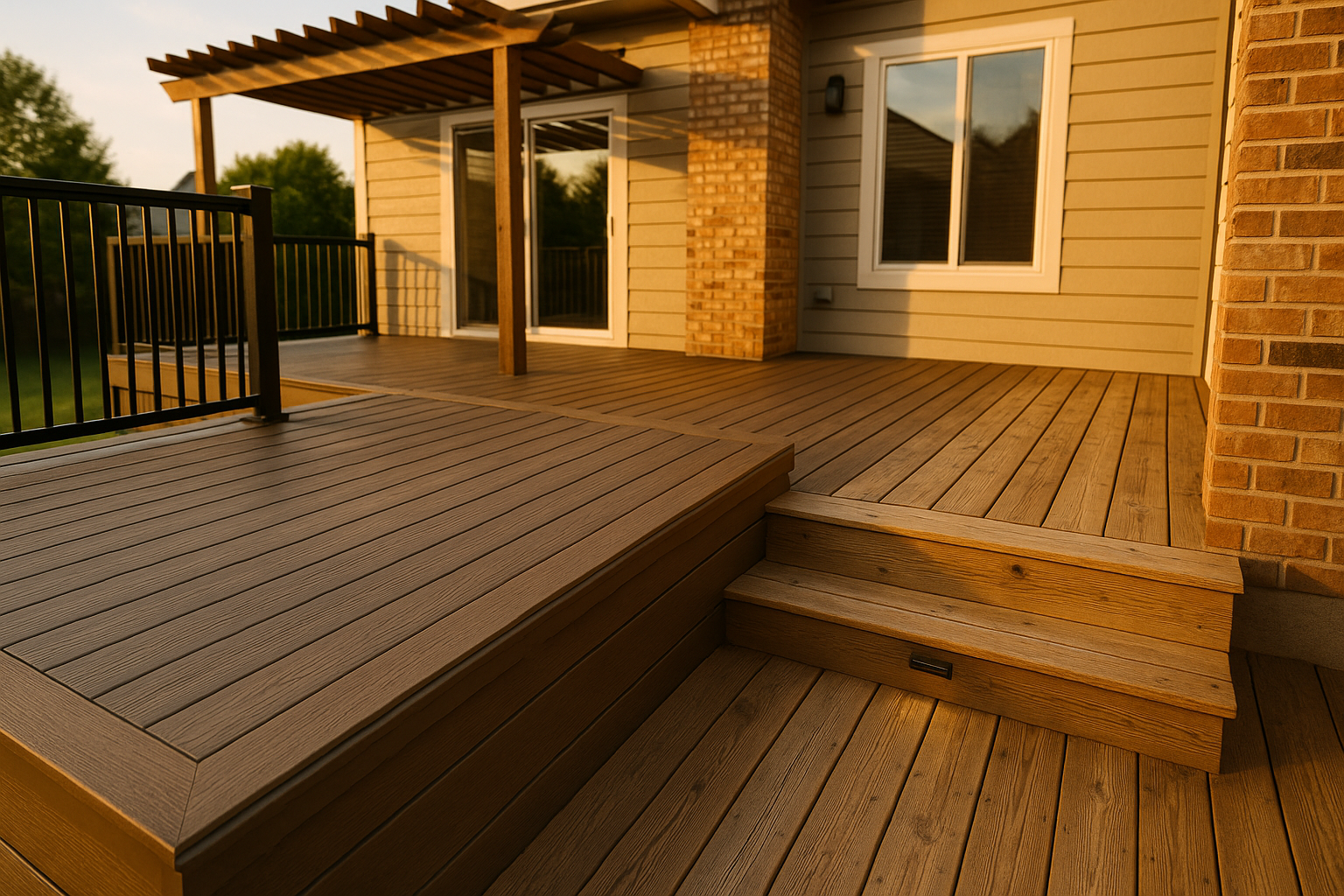
Composite handles moisture better. Capped composites (like Trex, TimberTech, and Fiberon) have a plastic shell that water beads off. No rot, no warping. And insects? Termites love wood. They don’t touch composite.
That said, composite isn’t perfect in our climate. Dark boards absorb heat. On a west-facing deck in Greenwood during July, you might not want to walk barefoot. Lighter colors help — think tan, gray, or warm brown. And if you’re planning a screened porch or low deck, make sure the framing has good airflow underneath. Moisture trapped under composite can still cause problems if the substructure isn’t right.
Maintenance: What You’re Signing Up For
Here’s the honest truth: wood is a hobby. You’ll need to clean, sand, and seal it every 1–2 years in Indiana. Miss a year, and the color fades. Miss two, and you’re looking at rot. It’s not hard work if you like that kind of thing, but most homeowners I talk to in Fishers and Noblesville just want to use their deck, not work on it.
Composite? Wash it once a year with a garden hose and mild soap. That’s it. No staining, no sealing, no sanding. For someone who works 50-hour weeks and has kids, that’s a huge win.
One thing nobody warns you about: leaf stains. In the fall, leaves sitting on a damp wood deck can leave dark marks. Composite handles that better — just blow them off. But if you let wet leaves sit for weeks on any material, you’ll get discoloration. So keep a blower handy.
How About Railing and Extras?
We do a lot of railing upgrades here. Wood posts rot at the base over time — seen it a hundred times in Greenwood and Plainfield. Composite posts and aluminum or cable rail are nearly maintenance-free. Cable rail (those thin stainless wires) looks modern and doesn’t block views. Aluminum rail is strong, doesn’t rust, and comes in colors that match composite decking. We also install a lot of black aluminum rail with composite — clean, timeless, and it works with any house style.
And if you have an older fence that needs updating, we can tie the look together. Same with patio enclosures — composite and metal rail transition nicely into a screened-in area. It all starts with that deck decision.
Freeze-Thaw, Ice, and Safety
Ice on a deck is dangerous, no matter the material. But some composites have better traction than others. Look for boards with an embossed wood grain or a high-traction finish. Avoid super-smooth surfaces if your deck faces north or gets shaded by trees. We see that a lot in Westfield neighborhoods with mature oaks.
When snow melts and refreezes, a textured composite gives your boots more bite. And don’t use metal shovels — they scratch composite. Plastic shovels only. For de-icing, stick with calcium chloride or products specifically approved for composite. Rock salt is bad for both wood and composite.
Permits and HOA: The Boring (But Important) Stuff
Indianapolis allows permits online, but their rules are strict. Marion County and Hamilton County both require permits for decks over 30 inches high. Footings need to be 36 inches deep (frost line). Beams and ledger flashing get inspected. If you’re in a subdivision in Carmel or Fishers, your HOA may have a say in color, railing style, and lot coverage.
Our team handles all that — we submit plans, pull permits, and talk to the HOA board. It saves you headaches. One homeowner in Avon told me his HOA rejected his first design because the rail spacing wasn’t “to standard.” We resubmitted with a revised plan and got approved in a week. Not a big deal when you know the process.
Resurfacing: A Smart Middle Ground
If your wood frame is still sound — no rot, no insect damage, proper footings — we can install new composite decking right over it. That saves money and time. It’s called a resurface. We inspect the frame, reinforce where needed, and lay new boards. You get the low-maintenance surface without tearing everything out.
But not every frame passes. In Brownsburg and Plainfield, I’ve seen frames that looked fine on top but had rotten joists underneath because the previous builder didn’t flash the ledger. If the frame is bad, a full tear-off and rebuild is the only safe route. We’ll tell you honestly which way to go.
So What’s the Best Decking Material for Indiana Winters?
Personally? I’d go composite, unless you really love the look and feel of real wood and are willing to maintain it. Composite gives you better long-term value in Indiana’s climate, especially if you pick a light color for heat management and a high-traction texture for safety. Brands like Trex and TimberTech hold up well here. Their warranties — 25–50 years against fading and staining — are a solid piece of mind.
If budget is tight, start with a smaller composite deck or choose wood but plan to upgrade later. We’ve helped plenty of homeowners in Greenwood and Zionsville do exactly that: build a frame that’s ready for composite down the road.
Your Next Step
Choosing between composite and wood is personal. It depends on your budget, how you use your deck, and how much maintenance you can handle. We offer free on-site consultations — we’ll look at your sun exposure, drainage, and framing, then give you a straight recommendation. No pressure, just a plan.
Ready to get started? Request a free quote. We serve Indianapolis, Carmel, Fishers, Zionsville, Westfield, Noblesville, Greenwood, Brownsburg, Avon, and Plainfield. Let’s build something that lasts.
Thinking about your own deck or pergola?
Free in-home design consultation, 3D rendering, and a written quote — no pressure.


